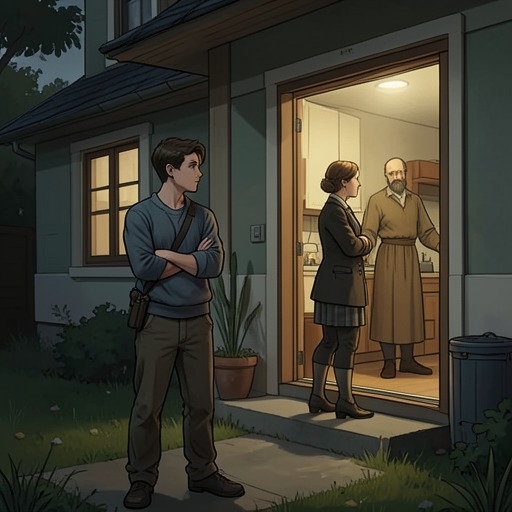
Drew Witthuhn—David Witthuhn
I'll Be Gone in the DarkDrew Witthuhn and David Witthuhn are brothers whose relationship comes into sharp focus after the 1981 murder of David’s wife, Manuela Witthuhn. Their shared history includes the suicide of their father and, later, the loss of Manuela; in the aftermath, brotherly loyalty does not spare Drew from asking David a direct and painful question. The relationship is defined instead by the difficulty of holding grief, suspicion, and trust together, and by Drew’s practical effort to help his brother return to a home transformed by violence.
Family History and Earlier Loss
Ten years before Manuela’s murder, the brothers experienced their father’s death in markedly different circumstances. Their father, Max Witthuhn, had locked himself in a room at the family home after an argument with his wife. Drew, then in eighth grade, was away at a school dance. David was eighteen and at home; after the sound of a gunshot, he broke down the door and shielded the rest of the family from what he saw. Their father died by suicide two weeks before Christmas.
The episode left David seeming less certain and more hesitant than before. His smile could appear, but his eyes did not; the account presents this change as part of the family’s lasting aftermath, not as a wound the brothers discuss directly. Drew was not present for the moment that placed David between the family and the immediate scene of their father’s death. That difference in what each brother faced helps establish a recurring contrast: David absorbs a family catastrophe first, while Drew later tries to stand beside him through another.
David eventually met Manuela and, in the account’s image, found solid ground again. That sense of stability makes her murder another devastating rupture in the brothers’ family life. The later crisis is not simply a matter of Drew assisting a bereaved relative; it brings back the history of David’s earlier loss while placing Drew in the position of deciding whether he can trust his brother under suspicion.
Drew’s Care for David After the Murder
David and Manuela lived at 35 Columbus, a single-story home in Northwood, Irvine. After police processed the house, they released it back to David on Saturday, February 7, 1981. The bedroom remained marked by the investigation, and the mattress had been cut in places so sections could be collected as evidence. Drew, training to become a police officer, volunteered to clean. He felt that he owed the work to his brother and considered himself a natural choice because of his police training.
Drew’s fiancée, who was studying to become a nurse practitioner, offered to help. Together they brought in bleach and buckets of water and wore yellow rubber gloves. Drew approached the task as a demand for composure and diagnostic steadiness, even though he was cleaning the room where his sister-in-law had been killed. In just under three hours, they cleared the house of the immediate signs of the crime and made it ready for David to return. The practical action mattered because it gave David back a home, while also requiring Drew to work directly inside the reality his brother had lost.
The cleanup did not leave Drew untouched. Once he had put the remaining supplies in his car and sat behind the wheel, he froze before starting the engine. Looking back at the house, he remembered arriving there previously and thinking that his brother had a good life. The memory and the present loss met in that pause; Drew then broke down and wept. The scene makes his care visible not as unshaken toughness but as an effort that eventually gives way to grief. His fiancée’s help that day also remained significant to him: even through the later low points of their relationship, he remembered her act of kindness. Their marriage lasted twenty-eight years, produced two sons, and ended in divorce, but the memory of their shared assistance to David endured.
Suspicion, Question, and Trust
Manuela’s funeral took place on February 11 at Saddleback Chapel in Tustin. Afterward, Drew returned with David to 35 Columbus, where the brothers sat talking late into the night. David was drinking heavily. He abruptly told Drew that the police thought he had killed Manuela. The disclosure placed Drew in a difficult position: his brother was grieving, but Drew’s police training also made him prepare himself to hear a confession. He did not believe David could have physically killed Manuela, yet he considered whether David might have arranged for someone else to do it.
Drew narrowed his attention to the question he believed he had to ask and asked David whether he had done it. The exchange briefly turns their family relationship into an investigation: Drew has to make room for suspicion long enough to ask, even though the possibility conflicts with his belief in his brother. David answered with certainty that he had not killed his wife. Drew had needed to hear the denial directly. Looking into David’s eyes, he judged that his brother was telling the truth and felt relief after holding the question in since learning of the murder.
That judgment does not erase the pressures surrounding the brothers. David carried survivor’s guilt, in part because he had been born with a hole in his heart and felt that, if anyone was to die, it should have been him. Manuela’s parents were grieving and looking for someone to blame, and their attention weighed on David. Against that burden, Drew’s decision to accept his brother’s answer becomes a defining act of trust, reached only after he has made himself ask the question plainly.
The Relationship’s Significance
The brothers’ relationship is shown through acts and decisions rather than through an extended account of their ordinary life together. David’s earlier experience of their father’s suicide, Drew’s decision to clean the house, and the late-night exchange after Manuela’s funeral form a sequence of family crises in which each brother encounters the other’s vulnerability. The evidence does not portray Drew as untouched by doubt, or David as free of grief; it shows Drew taking responsibility for a difficult conversation and then believing the answer he receives.
Their shared history gives the aftermath of Manuela’s murder a particular weight. David had once faced their father’s death and shielded his family from what he saw; now Drew takes on the work of restoring David’s home and, later, listens as David fears that even his own brother may suspect him. The relationship’s decisive movement is from service to questioning to renewed trust. Drew cannot undo either loss, but he helps David return to the house and makes clear, after hearing him, that the police suspicion has not displaced his confidence in his brother.